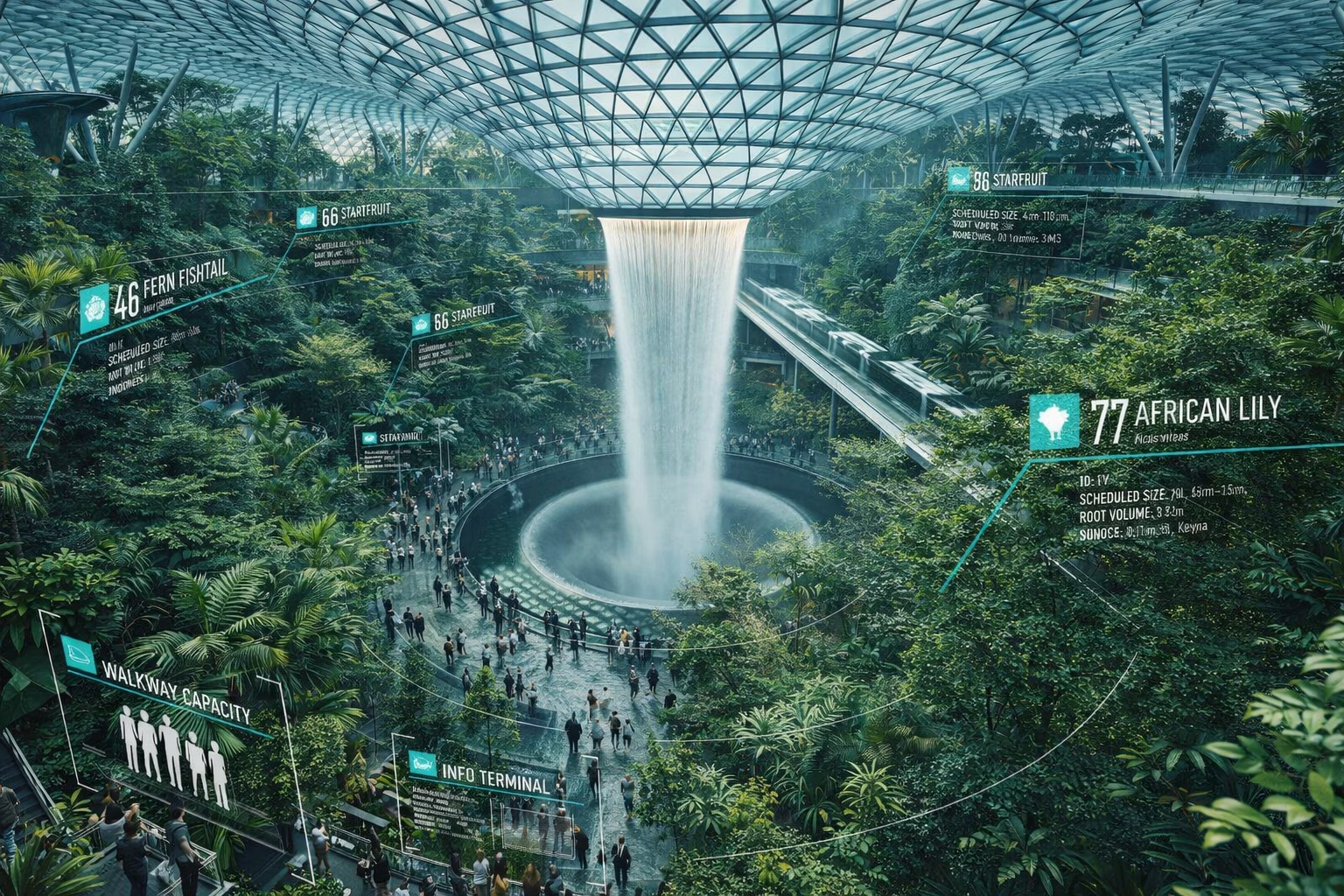
What is Cyberparadism?
Cyberparadism is a techno-optimist futuristic aesthetic that juxtaposes lush or dramatic natural environments with a small, highly advanced human habitat—typically a “breakaway” settlement that uses sophisticated (often plausibly speculated) technology to achieve comfort, resilience, and a sense of paradise. It emerged in online aesthetics communities in the 2010s (and earlier precursors are sometimes cited), and is discussed primarily as a visual and narrative style rather than a formal political program.
Cyberparadism is frequently described as post-cyberpunk in mood: it retains “high tech” but does not center the “low life” social decay associated with cyberpunk. Its defining image is not the endless neon city, but an enclave—minimal, intentional, and technologically mature—embedded within wilderness, coasts, mountains, or terraformed frontiers.
Terminology and scope
Other names. The term is sometimes paired with or substituted by Cyber Paradise, Cybergenesis, and Neogenesis/Neogenesism (usage varies by community).
Aesthetic-first framing. Cyberparadism is best understood as a style system: a cluster of recurring visual motifs, compositional habits, and story tropes. When it is extended into “real-world” inspiration (architecture, product design, or lifestyle moodboards), it remains primarily aesthetic—i.e., a set of cues for what “the cyber paradise” looks and feels like—rather than a blueprint for governance.
Core ethos (as an aesthetic)
Cyberparadism’s ethos can be summarized as:
- Optimism about technological maturity: advanced tools are depicted as enabling abundance, safety, and leisure rather than surveillance, scarcity, or collapse.
- Nature as a primary stage: the surrounding environment is not an afterthought; it is the dominant canvas.
- Enclosure and community: humans gather in designed “centers” (plazas, agoras, forums, open-air auditoriums), with the built world acting as a small, coherent island inside a larger landscape.
- Minimalism by sophistication: technology is depicted as cleaner and less materially noisy—fewer visible machines, fewer cluttered interfaces, more seamless integration.
A commonly quoted motto in community descriptions is:
“Sophistication of technology is the gateway to abundance and prosperity.”
Typical settings and narrative tropes
Cyberparadism is flexible about where it takes place. Common settings include:
- Earthbound enclaves: off-grid or semi-off-grid settlements with advanced energy, water, food, and medical systems.
- Exoplanets and space-frontier habitats: colonies, domes, and carefully engineered ecologies beyond Earth.
- Terraforming and biosphere engineering: landscapes and ecosystems shaped by long-horizon engineering (sometimes subtly, sometimes overtly).
Recurring tropes include:
- Resource abundance / post-scarcity vibes: not necessarily explained in economic detail, but implied through effortless comfort, longevity, and high-quality built environments.
- Genetic life engineering and synthetic biology: curated flora/fauna, cloning, designed organisms, or “new Eden” biodiversity.
- High-gain closed-loop systems: energy, water, waste, and agriculture shown as circular, efficient, and elegant.
Visual language
1) Landscapes and environment
Cyberparadism foregrounds wide natural scenes:
- dense, saturated greens (junglecore adjacency),
- coastal and tropical environments (beaches, lagoons, bright horizons),
- dramatic geology (cliffs, volcanic ridges, desert expanses),
- barren exoplanet surfaces contrasted with carefully maintained habitats.
The environment often dominates the composition; the human habitat reads as a deliberate insertion into the world rather than total replacement of it.
2) Architecture and “the enclave”
The built environment commonly appears as:
- small, coherent clusters (not planet-wide megacities),
- highly refined minimalism (clean surfaces, few visible seams),
- materials that read as durable and “future-clean” (white ceramics, polished stone, bright concrete, glass-like composites),
- public spaces designed for gathering (plazas, amphitheater forms, promenades).
A recurring compositional pattern is “enclosure”: the habitat is framed as a bounded garden, campus, dome, crater-city, or terraced complex within a much larger wilderness.
3) Interfaces and technology cues
Cyberparadism often implies advanced technology without fetishizing machinery:
- mind-based or sensory interfaces (subtle wearables, ambient UI, minimal screens),
- automation that is “quiet” and embedded,
- biotech and nanotech suggested through surface textures or seamless integration.
4) Shape language
Cyberparadism favors simple geometric primitives and biomimetic geometry, often repeated across structures:
- spheres, cones, domes,
- pyramids, hexagons,
- helical/double-helix motifs,
- fractal or lattice patterns.
These shapes are commonly framed as both aesthetic (clean, legible) and functional (efficient, modular, sustainable).
5) Color palette
A frequently cited Cyberparadism palette emphasizes saturated aquas/greens with high-contrast neutrals and a single vivid accent:
| Color | Hex |
|---|---|
| Teal | #008080 |
| Aquamarine | #7FFFD4 |
| Jungle Green | #29AB87 |
| Turquoise | #40E0D0 |
| Cyan | #00FFFF |
| Folly (accent) | #FF004F |
| Silver | #C0C0C0 |
| Platinum | #E5E4E2 |
| Charcoal | #333333 |
| White | #FFFFFF |
In practice, creators often use this palette as a guideline rather than a constraint: aquas/greens communicate water, canopy, and coastal brightness; silvers/whites communicate precision and cleanliness; the accent color introduces “signal” (alerts, highlights, branding).
What Cyberparadism is not (common distinctions)
Cyberparadism is often clarified in contrast to neighboring aesthetics:
- Not “cyberpunk.” Cyberparadism typically avoids the “high tech, low life” framing and the city-as-cage visual grammar.
- Not generic “futuristic environmentalism.” Nature is central, but the aesthetic is defined by the nature + advanced enclave relationship.
- Not necessarily Solarpunk. Both can depict green futures, but Cyberparadism tends to be more high-tech, minimalist, and engineered, while Solarpunk is frequently associated with visible craft, DIY, and communal artisanry.
- Not automatically “utopia.” Many works use the “paradise” surface to later complicate it (e.g., the enclave’s costs, exclusions, or hidden control). This is a narrative move that can appear even in otherwise optimistic styling.
Related aesthetics and influences
Cyberparadism is commonly positioned adjacent to:
- Post-cyberpunk (optimistic re-framing of advanced tech),
- Cyberprep / clean-future tech minimalism,
- Solarpunk (overlapping green-future imagery),
- Y2K futurism (clean curves, consumer-tech optimism),
- Junglecore / tropical maximal nature (environmental staging),
- broader minimalist and “glass/clean” design movements.
Its influence vocabulary often draws from futurism, systems design imagery (closed loops, habitats, domes), space-frontier iconography, and modernist/neo-modern architectural language—filtered through internet aesthetics culture.
Media and usage
Cyberparadism tends to appear as:
- set dressing for “advanced enclave” locations within broader sci-fi works,
- concept art for habitats, domes, and terraced campuses,
- design language for speculative products (wearables, shelter systems, lifestyle tech),
- moodboards that combine nature cinematography with polished futurist architecture.
Because it is aesthetic-first, Cyberparadism is commonly used as a visual shorthand: it quickly communicates “high capability + high comfort + controlled footprint + wild surroundings.”
Quick checklist for identifying Cyberparadism imagery
A piece of art is often read as Cyberparadist when most of these are true:
- The environment is wild, lush, or geologically dramatic.
- The built world is small relative to the landscape.
- The built world looks highly advanced, clean, and minimalist.
- Technology feels mature and quiet, not industrial or improvised.
- The mood is optimistic, serene, or sensually pleasurable rather than gritty or anxious.
- The composition implies enclosure / campus / garden / habitat.
References and further reading
- Cyberparadism (manifesto site): https://zarazinsfuss.github.io/cyberparadism/
- Cyberparadism Manifesto repository: https://github.com/zarazinsfuss/cyberparadism-manifesto
- Cyberparadism entry (Personal Aesthetics Wiki – Fandom): https://personal-aesthetics.fandom.com/wiki/Cyberparadism