Field guide · 01
What is Cyberparadism?
A techno-optimist aesthetic that sets a small, highly advanced human habitat inside lush or dramatic nature.
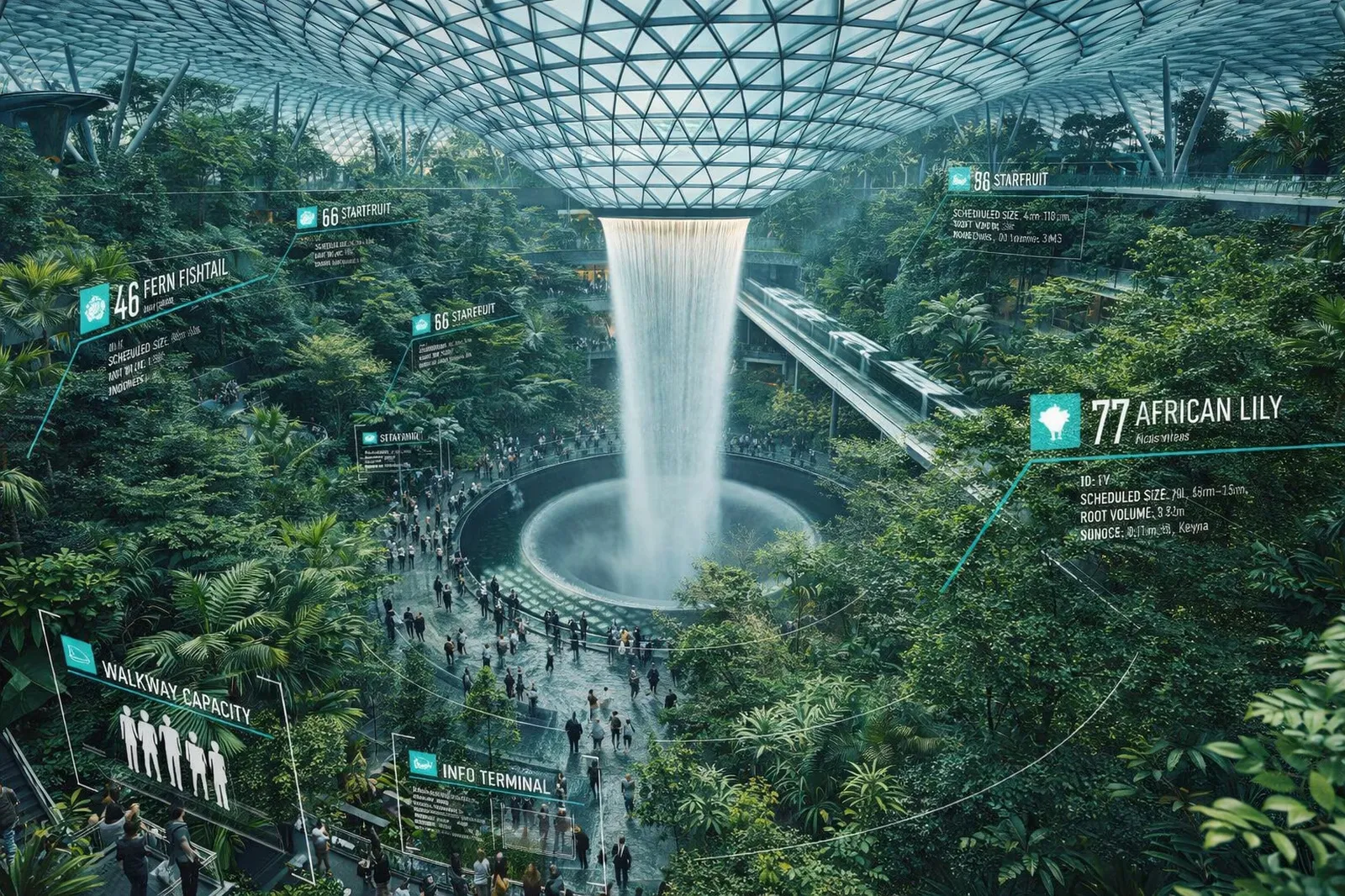
Cyberparadism is a techno-optimist futuristic aesthetic that juxtaposes lush or dramatic natural environments with a small, highly advanced human habitat: typically a “breakaway” settlement that uses sophisticated, often plausibly speculated technology to achieve comfort, resilience and a sense of paradise. It emerged in online aesthetics communities in the 2010s, with earlier precursors sometimes cited, and it is discussed primarily as a visual and narrative style rather than a formal political program.
Cyberparadism is frequently described as post-cyberpunk in mood. It keeps the “high tech” but does not center the “low life” social decay associated with cyberpunk. Its defining image is not the endless neon city but an enclave, minimal, intentional and technologically mature, embedded within wilderness, coasts, mountains or terraformed frontiers.
Terminology and scope
Other names. The term is sometimes paired with or replaced by Cyber Paradise, Cybergenesis and Neogenesis or Neogenesism. Usage varies by community.
Where it is filed. The Personal Aesthetics Wiki entry, the aesthetic’s first formal description, files Cyberparadism as a subset of Cyberprep and traces its optimism back to the early twentieth-century avant-garde’s break with historical revival styles. The related chapter takes up both points.
Aesthetic-first framing. Cyberparadism is best understood as a style system: a cluster of recurring visual motifs, compositional habits and story tropes. When it is extended into real-world inspiration, for architecture, product design or lifestyle moodboards, it remains primarily aesthetic: a set of cues for what the cyberparadise looks and feels like, rather than a blueprint for governance. The manifesto says the same in its own words: it is not a political or economic manifesto.
Core ethos
Four commitments run through nearly every work that reads as Cyberparadist:
- Optimism about technological maturity. Advanced tools are depicted as enabling abundance, safety and leisure rather than surveillance, scarcity or collapse.
- Nature as the primary stage. The surrounding environment is not an afterthought. It is the dominant canvas.
- Enclosure and community. Humans gather in designed centers, such as plazas, agoras, forums and open-air auditoriums, and the built world acts as a small, coherent island inside a larger landscape.
- Minimalism by sophistication. Technology is depicted as cleaner and less materially noisy: fewer visible machines, fewer cluttered interfaces, more seamless integration.
A motto commonly quoted in community descriptions compresses all four:
“Sophistication of technology is the gateway to abundance and prosperity.”
Reading the Laws
The manifesto’s eight Laws, Abundance, Equity, Freedom, Harmony, Preservation, Recognition, Responsibility and Simplicity, are declared “not hierarchical in nature, but rather complementary facets of a whole”. Read that way they work as mutual constraints rather than a ranked list. Equity, a universal baseline, is paired with Recognition, reward for individual contribution, so that neither cancels the other. Harmony and Preservation carry the signature demand that technology be integrated with the living world rather than imposed on it. Responsibility weighs the cost of great technological power, and Simplicity makes minimalism a design principle rather than a style. This is why Cyberparadism reads as the aesthetic of an integrated way of life rather than a priority-ordered program, and why a scene can wear the look while breaking the Laws; the distinctions chapter collects such cases.
Etymology
The name joins cyber- to paradise. The prefix descends from the Greek kybernētēs, a steersman, and entered modern vocabulary through Norbert Wiener’s Cybernetics in 1948. From there it spread: cyborg in 1960, cyberspace in William Gibson’s story “Burning Chrome” in 1982 and his novel Neuromancer in 1984, and cyberpunk as a label by the middle of that decade. Paradise runs the other way in time, from Old Persian paridaida, a walled enclosure, through Greek paradeisos, the word the Septuagint chose for the garden of Eden at Genesis 2:8. The compound therefore reads as “cybernetic paradise”: the oldest word for a walled garden, fitted to the machine age. It suits an aesthetic whose signature composition is a bounded garden inside a larger wilderness; see enclosure.
How to read the rest of this guide
The chapters that follow take the ethos apart into things you can see. Settings and tropes covers where the aesthetic takes place and which stories it tells. Visual language covers landscape, architecture, interfaces and composition. Shape language and Palette are the vocabulary. Distinctions draws the borders with neighbouring aesthetics, Related lists the influences, the Checklist is for recognizing and making it, and the Glossary defines the terms.