Field guide · 07
Related aesthetics and influences
The neighbours Cyberparadism borrows from, the ideas behind it, and where to read more.
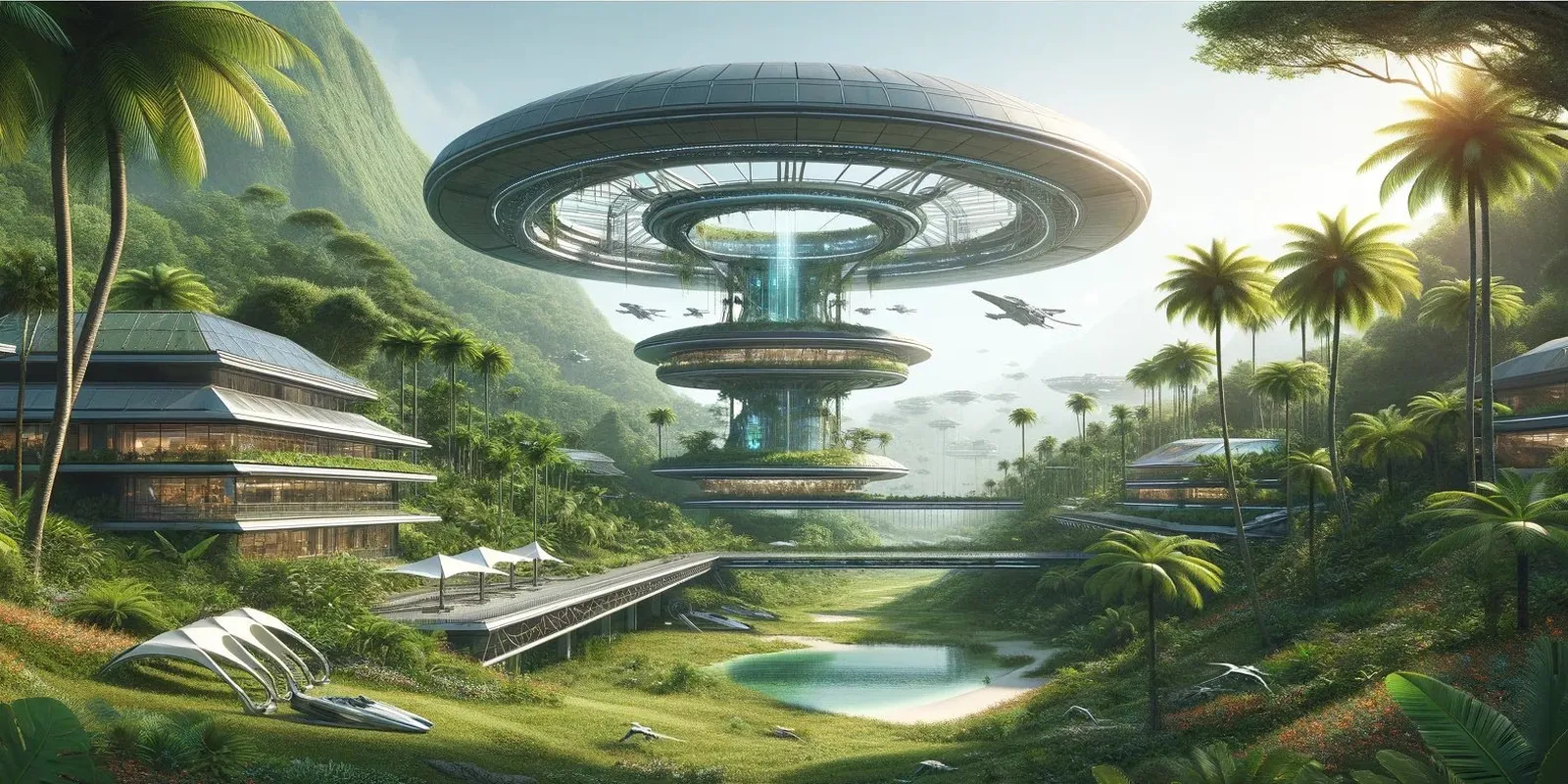
Adjacent aesthetics
Cyberparadism is commonly positioned next to:
- Post-cyberpunk: the optimistic reframing of advanced technology after cyberpunk’s warnings.
- Cyberprep and clean-future tech minimalism: polished, affluent, frictionless futures. The Personal Aesthetics Wiki files Cyberparadism as a subset of Cyberprep; the difference is the wilderness, which Cyberprep does not require.
- Solarpunk: overlapping green-future imagery with a different politics and texture; see the distinctions.
- Y2K futurism: clean curves, translucent materials and consumer-tech optimism around the turn of the millennium.
- Junglecore and tropical maximal nature: the environmental staging.
- The broader family of minimalist and “glass and clean” design movements.
Design lineage
The built forms in the gallery have real ancestors, and naming them helps makers draw on the originals rather than on copies of copies.
- Buckminster Fuller: the geodesic dome, and the whole-systems thinking of Operating Manual for Spaceship Earth (1969). The aesthetic’s domes and lattices descend from here.
- Frei Otto: lightweight tensile and shell structures, from Das hängende Dach (1954) to the Munich Olympic roofs (1972). The source of the aesthetic’s light, glazed enclosures.
- Paolo Soleri: the arcology, a dense, ecologically integrated habitat set out in Arcology: The City in the Image of Man (1969). The small, coherent enclave as a deliberate design rather than a sprawl.
- Janine Benyus: Biomimicry (1997), design that learns from living systems. Behind the branching columns, helices and grown-looking structures in the shape vocabulary.
Fiction and film
No single work is Cyberparadist from end to end, but a short shelf supplies most of the aesthetic’s moods and scenes.
- Thomas More, Utopia (1516): the head of the Western tradition of the designed good society.
- Star Trek, the Federation: a post-money society on a cosmic frontier, the most widely seen version of the vision.
- Iain M. Banks, the Culture novels (1987 to 2012): the fullest literary treatment of post-scarcity abundance with mature, quiet technology.
- Ursula K. Le Guin, The Dispossessed (1974): Anarres, a cooperative society with advanced science; the aesthetic’s seriousness about equity.
- Neal Stephenson, The Diamond Age (1995): post-cyberpunk, mature molecular manufacturing and what it does to a society.
- Hayao Miyazaki: Nausicaä of the Valley of the Wind (1984), Castle in the Sky (1986) and Princess Mononoke (1997). Technology and restored nature held together, and in Mononoke a hard negotiation between them rather than a simple harmony.
- WALL-E (2008) and Tomorrowland (2015): popular film’s reconciliations of technology with a recovered green world.
Adjacent ideas
Readers arrive at Cyberparadism from several contemporary debates, and it is worth saying how the aesthetic relates to them without joining them. Post-scarcity economics, Fully Automated Luxury Communism (Aaron Bastani, 2019), universal basic income and the abundance writing of Peter Diamandis and Steven Kotler all treat automation as the infrastructure of an abundant society, which is the condition the aesthetic depicts. Techno-optimism and its accelerationist currents, including the Techno-Optimist Manifesto, share the confidence in technology but press it toward growth as such. Cyberparadism’s picture insists on something those currents do not require: ecological integration and a small footprint. The aesthetic is a picture of a destination, not a position on how to reach it; the manifesto says the same in its own words.
Influence vocabulary
The aesthetic draws on futurism, systems-design imagery (closed loops, habitats, domes), space-frontier iconography, and modernist and neo-modern architectural language, all filtered through internet aesthetics culture. Two older ideas sit underneath much of it:
- Ephemeralization, Buckminster Fuller’s term for doing more and more with less and less, which is the shape of the aesthetic’s “minimalism by sophistication”.
- Spaceship Earth, the planet as one vessel with finite resources and a shared crew, which is the enclave written large.
Media and usage
Cyberparadism tends to appear as:
- set dressing for advanced-enclave locations inside broader science-fiction works;
- concept art for habitats, domes and terraced campuses;
- design language for speculative products: wearables, shelter systems, lifestyle technology;
- moodboards that combine nature cinematography with polished futurist architecture.
Because it is aesthetic-first, it is commonly used as a visual shorthand: it quickly communicates “high capability, high comfort, controlled footprint, wild surroundings”.
Further reading
- The Cyberparadism entry on the Personal Aesthetics Wiki, where the aesthetic was first formalized. The older address on the main Aesthetics Wiki no longer exists.
- The Cyberparadism entry in the Wheel of Heaven wiki, which reads the aesthetic within that project’s own framework and carries an extensive bibliography of the design and fiction lineage above.
- The Cyberparadism Manifesto, with its source repository on GitHub.
- Marc Andreessen’s Techno-Optimist Manifesto, a narrower, economic cousin of the same optimism; the manifesto’s closing section describes the difference.
- The
#cyberparadismtag on Tumblr and TikTok.