Field guide · 03
Visual language
Landscape, architecture, interfaces and composition: what a Cyberparadist image is made of.
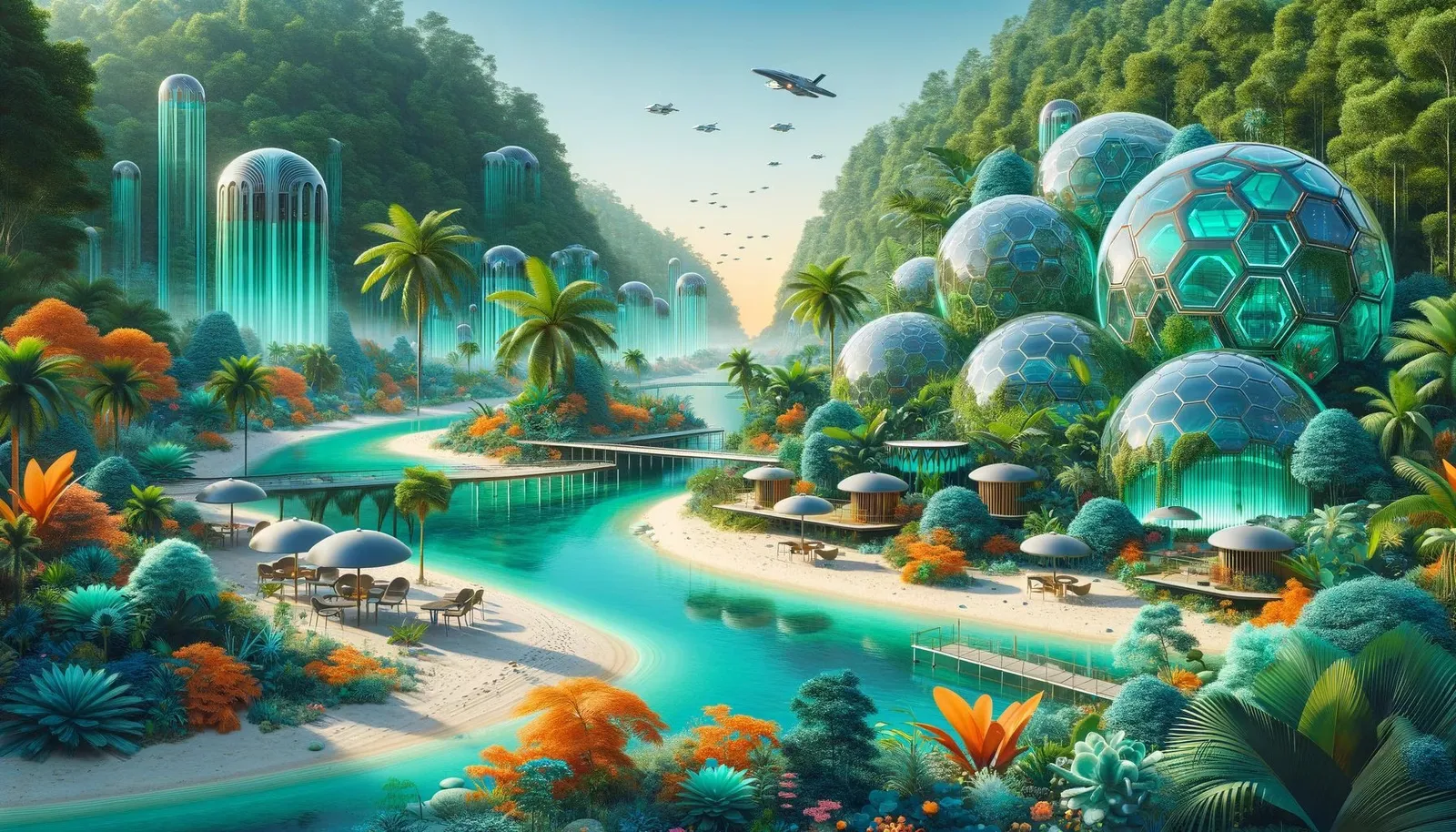
If the ethos is the why, this chapter is the what. Four layers build most Cyberparadist images: the landscape, the built enclave, the technology cues, and the way they are composed.
Landscape and environment
Cyberparadism foregrounds wide natural scenes:
- dense, saturated greens, with a clear adjacency to junglecore;
- coastal and tropical environments: beaches, lagoons, bright horizons;
- dramatic geology: cliffs, volcanic ridges, desert expanses, waterfalls;
- barren exoplanet surfaces contrasted with carefully maintained habitats.
The environment usually dominates the composition. The human habitat reads as a deliberate insertion into the world rather than a replacement of it. A good rule of thumb: if the built world takes more than a third of the frame, the image is drifting toward a different aesthetic.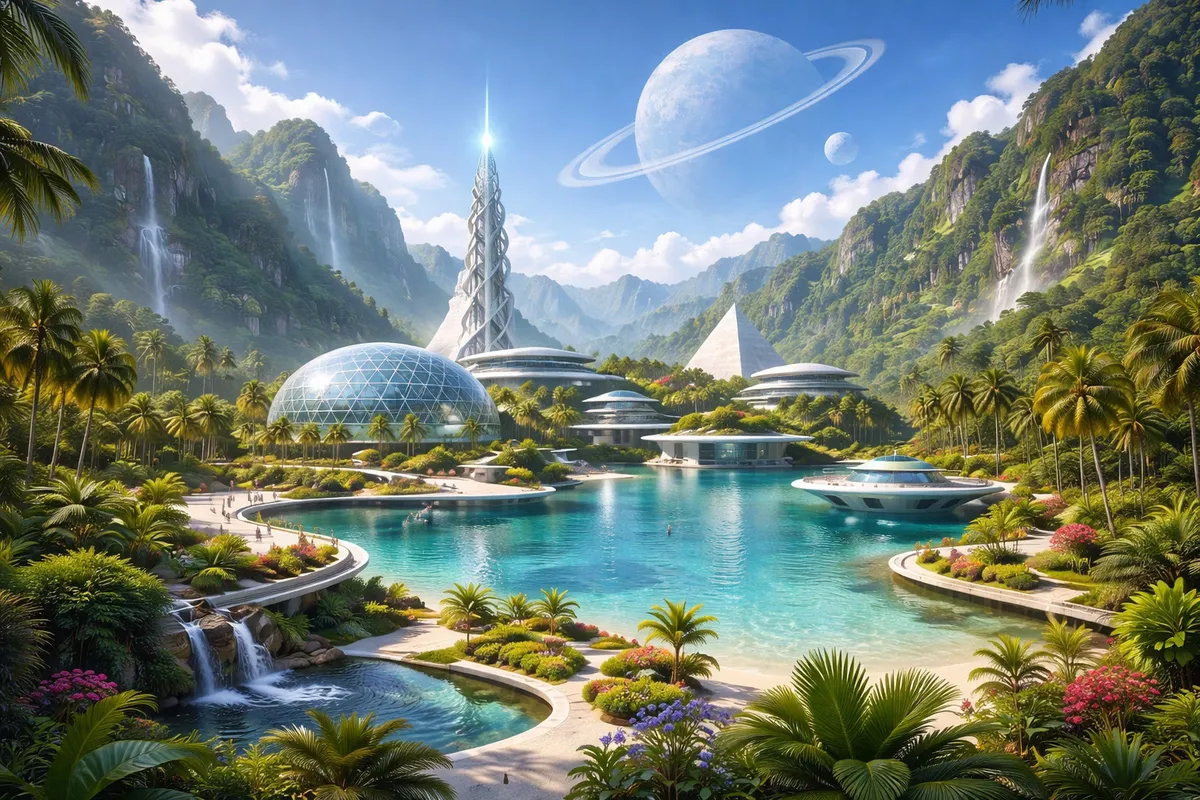
Architecture and the enclave
The built environment commonly appears as:
- small, coherent clusters, not planet-wide megacities;
- highly refined minimalism: clean surfaces, few visible seams;
- materials that read as durable and future-clean: white ceramics, polished stone, bright concrete, glass-like composites;
- public spaces designed for gathering: plazas, amphitheater forms, promenades, pools.
A recurring compositional pattern is enclosure. The habitat is framed as a bounded garden, campus, dome, crater-city or terraced complex within a much larger wilderness. The boundary is usually visible: a ring, a shell, a lattice, a shoreline.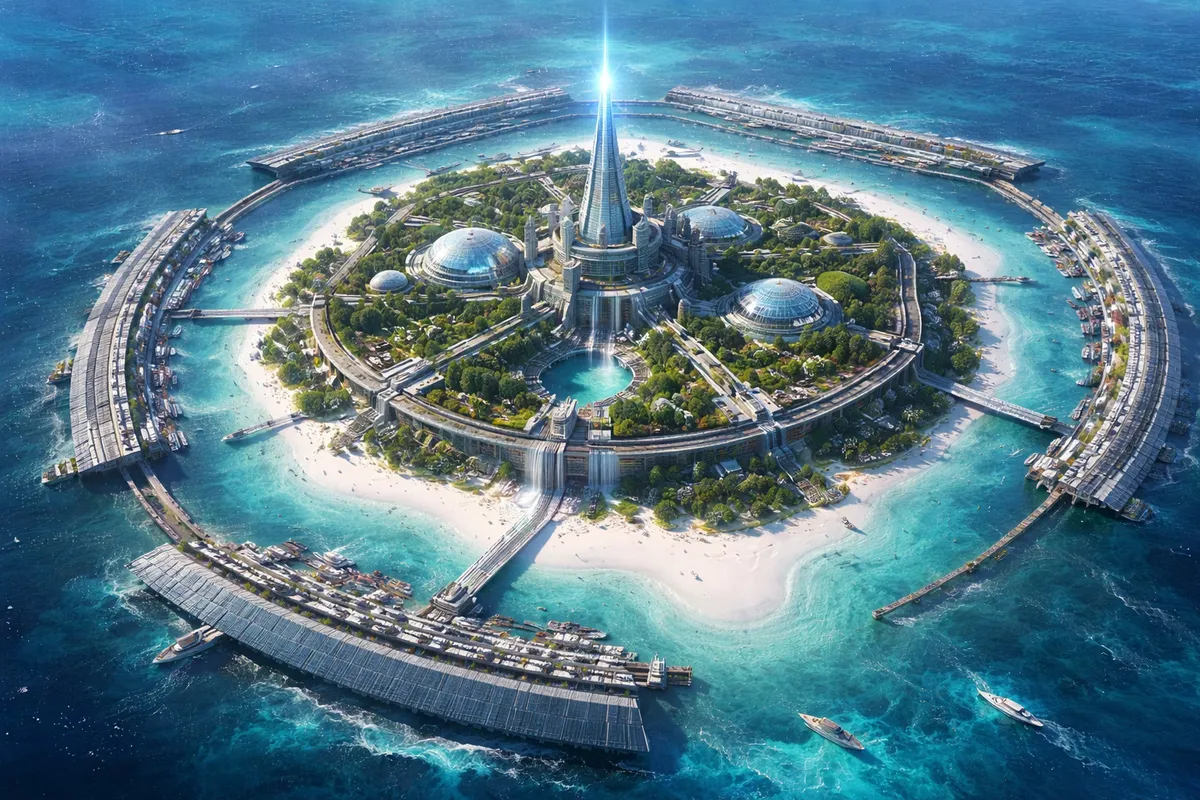
Interfaces and technology cues
Cyberparadism implies advanced technology without fetishizing machinery:
- mind-based or sensory interfaces: subtle wearables, ambient UI, minimal screens;
- automation that is quiet and embedded;
- biotech and nanotech suggested through surface textures or seamless integration rather than through visible apparatus.
When an interface is shown, it tends to float in the environment as a thin annotation rather than sit on a device: a label on a plant, a capacity reading on a walkway, a route drawn in the air. The information belongs to the place.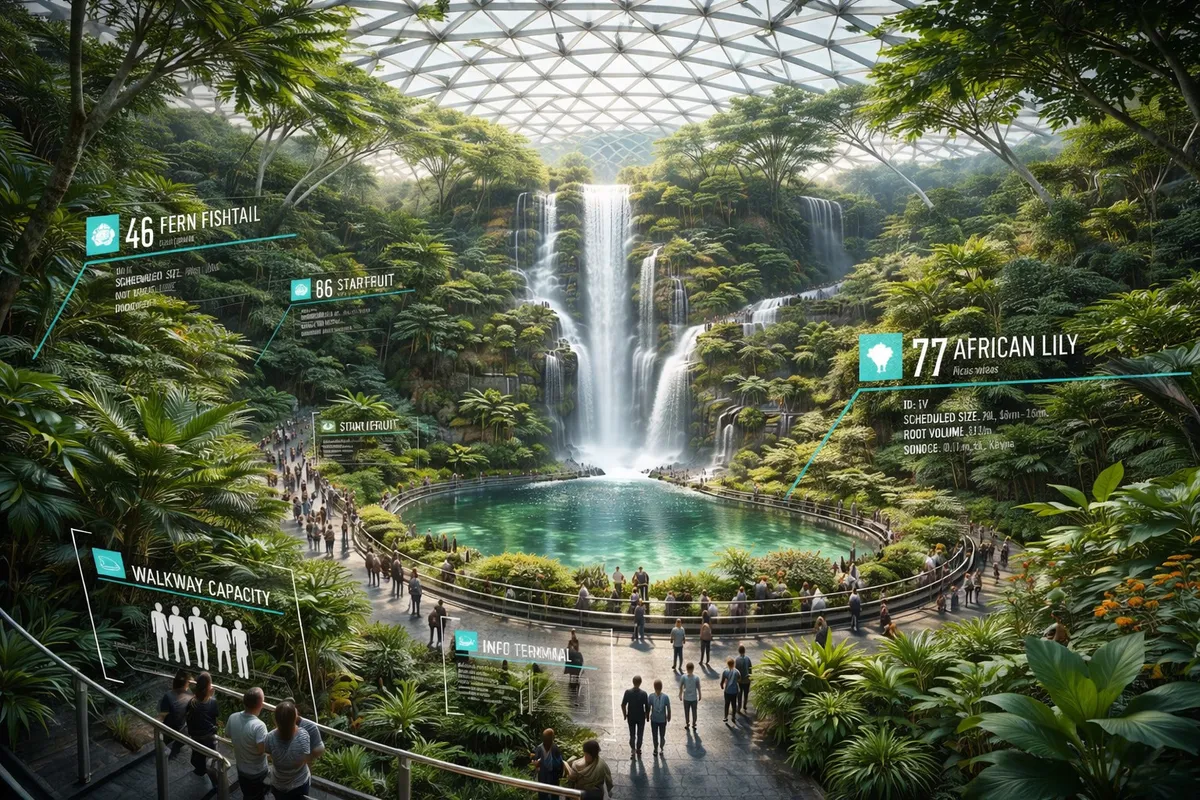
Composition
Patterns that recur across the gallery and the wider body of work:
- Scale ratio. Nature large, enclave small, people smaller still. A single figure is common and establishes scale without crowding.
- Horizon and depth. A high horizon or an elevated viewpoint, so that the landscape can keep going behind the habitat. Aerial views are frequent.
- Light. Daylight, often late morning or early evening; soft haze over distance; glass that glows faintly from within. Night scenes exist but are rare, and when they appear they are starlit rather than neon-lit.
- Order against wildness. Clean geometry set against irregular foliage and rock. Neither side is tidied to match the other.
- One vivid accent. A flower bed, a flag of orange foliage, a single warning light. The rest of the palette stays in aquas, greens and neutrals; see the palette.
What to leave out
Smoke, rust, wires, crowds, advertising, visible weapons, clutter of any kind. Their absence is most of what makes the technology read as mature.